Condition grading
A Fine copy and a Very Good copy of the same printing are not the same book in the market. On this site a Very Good / Very Good copy is valued at 60% of a Fine / Fine one. This page shows you how to see that difference before you pay for it.
This is an educational guide for new collectors, not a professional appraisal. Dealers do not apply these words identically. Read the description and the photos, not just the grade on the invoice.
How we grade
The scale follows the convention used by AB Bookman and the Independent Online Booksellers Association: Fine, Near Fine, Very Good, Good, Fair, and Poor. Some dealers write As New above Fine. This site’s scale stops at Fine, so an unread, as-issued copy is graded Fine here.
Grades are written book first, jacket second: NF/VG is a Near Fine book in a Very Good jacket, and VG/No DJ is a Very Good book with no jacket. The abbreviations are F (Fine), NF (Near Fine), VG (Very Good) and G (Good). Fair and Poor are written out, so Fair is never confused with Fine.
Three things look like grades and are not:
- A missing jacket is a completeness penalty, not a Fair or Poor trait. The book is graded on its own, then the penalty is applied.
- A missing page of text makes an incomplete copy. It sits outside the scale and has to be described as incomplete.
- A book club edition is a different edition, not a lower grade of the trade printing. See book club editions.
Fine through Poor
Each grade lists what to look for, how the copy feels in the hand, and when it is a sensible buy.
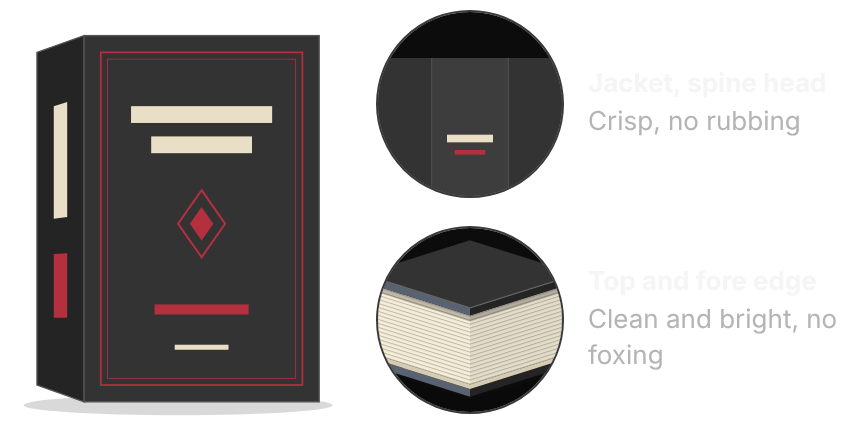
Fine (F)
- Look for
- Looks as issued. Spine square, corners sharp, no fade, no marks, no owner inscriptions. Jacket complete, unclipped, bright, no tears or chips.
- In the hand
- Opens quietly. Hinges firm. Pages clean, no grit. No smoke or musty odors.
- Buy it when
- You want a top copy and the price reflects it. Expect to pay full True Value.
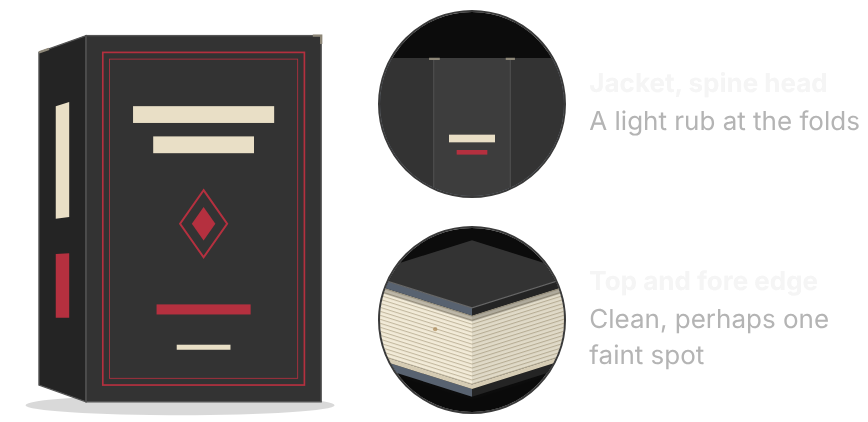
Near Fine (NF)
- Look for
- Almost Fine, with up to a few minor imperfections you have to look for: a light rub at the spine ends, one gently bumped corner, a faint spot or two on the top edge.
- In the hand
- Opens quietly. Hinges firm. Pages clean, no grit. No smoke or musty odors.
- Buy it when
- You want a copy that is nearly indistinguishable from Fine, but at a lower price.
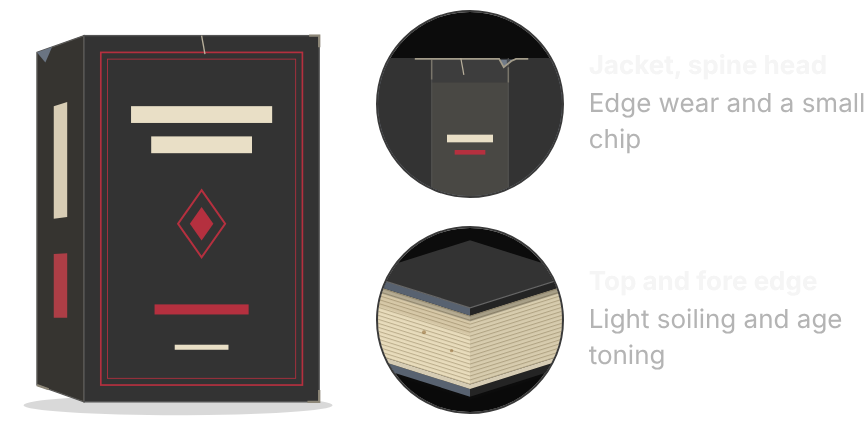
Very Good (VG)
- Look for
- Visible wear, still complete and sound. Small closed tears or chips to the jacket, moderate spine fade (considering the book’s age), light edge soiling.
- In the hand
- Slight crackle on opening. Mild spine lean. Some looseness in the binding.
- Buy it when
- You want the printing more than the condition, or the title is expensive in higher grades.
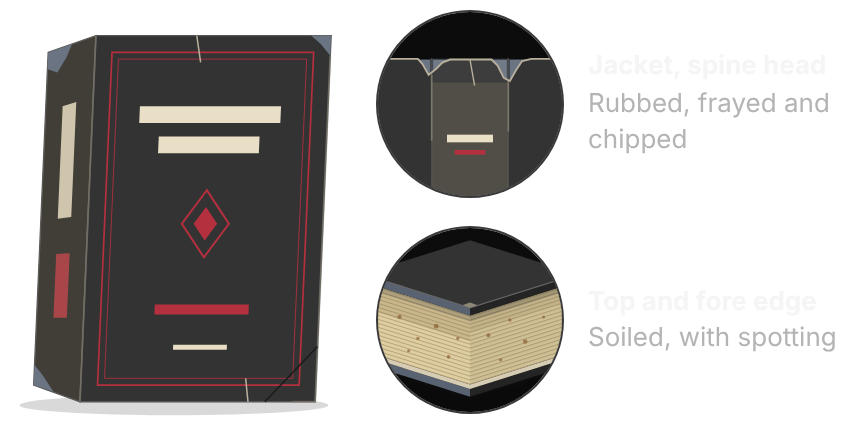
Good (G)
- Look for
- An average, well-used copy. Heavy rubbing, bumped or frayed corners, a cocked spine, owner inscriptions or stamps, jacket with chips, tears or old tape. All text present; binding holds.
- In the hand
- Obvious lean. Play in the hinges. The text block shifts a little between the boards.
- Buy it when
- You want an affordable copy of a particular printing, or a better condition copy is difficult to find.
Fair
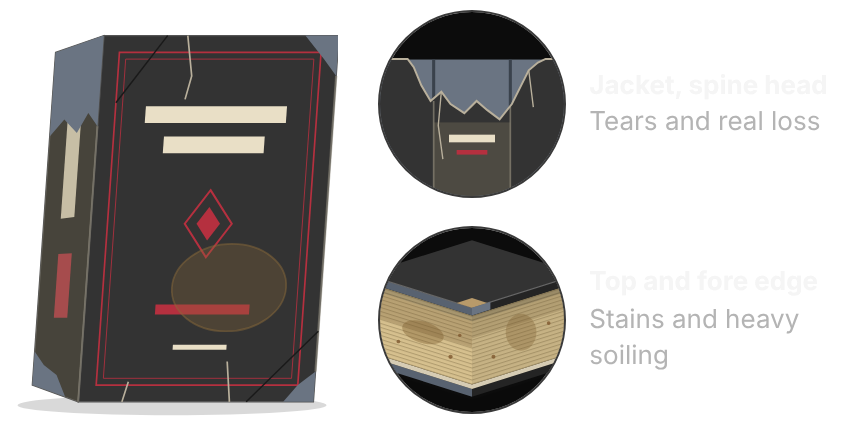
- Look for
- Heavy wear, but text complete. Stains, heavy soiling or fading, binding shaken or starting to separate. Jacket, if present, is tattered.
- In the hand
- The text block moves relative to the boards. Boards flex. Joints may be split.
- Buy it when
- You want an affordable reading copy or a scarce early printing despite its condition.
Poor
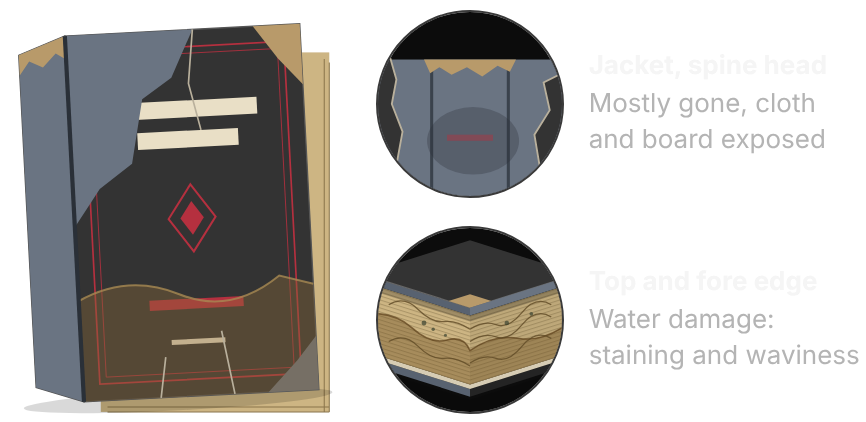
- Look for
- Boards detached, pages loose, heavy water or mold damage, ex-library abuse. Text is still complete and legible; a copy with missing text is an incomplete copy, not a Poor one. Jacket, if present, may be in pieces.
- Gentle handling
- Handle briefly and support every hinge; more handling means more damage.
- Buy it when
- You want a truly scarce printing at a price that reflects the state.
Value floor. Scarce early printings (for example trade first printings of Carrie or ’Salem’s Lot) can retain significant True Value even in Good or Fair condition. Common later titles in Fair or Poor are generally reading copies.
Incomplete copies. Missing plates or maps make the copy incomplete as issued; this must be stated prominently and usually means Fair or Poor.
Before you buy: inspection checklist
Check a copy in this order. Handle it gently: if the book doesn’t open easily, don’t push it. A tight binding is a good sign, and forcing it can crack the hinge.
- Jacket front, spine and back. Chips, closed tears, tears with paper loss, creases, rubbing, and spine fade. Compare the spine color with the front panel.
- Jacket flaps. Is the printed price on the flap present or clipped? Is it the right price for this printing? Any “Book Club Edition” wording?
- Inside the jacket. Turn it over. Tape, paper reinforcement, or touched-in color means repair or restoration. Check for water staining. Check whether the jacket is a facsimile.
- Boards and corners. Bumps, fraying, rubbing, tears or peeling of the covering material, stains, warping, and wear to foil stamping or lettering. A small blind-stamped mark low on the rear board may indicate a book club edition.
- Spine. Spine straight or leaning. Ends crushed or frayed. Lettering bright, faded, or rubbed. Check for creases, tears, and fading.
- Hinges and gutter. Open each cover gently until it moves freely and stop at any resistance. Don’t force it flat. Look for cracks at the hinge, exposed mesh or cords, or torn endpapers.
- Front and rear endpapers. Owner names, gift inscriptions, bookplates, price stickers, tape residue, erased pencil.
- Title and copyright page. Check the edition statement, printing line, and any gutter codes or other identifying marks. Confirm the printing against the identification points on that title's catalog page.
- Page block. Fan gently. Tears, stains, underlining, dog-ears, loose or missing leaves (pages), wavy (cockled) paper.
- Three text block edges. Top, fore-edge, and bottom: foxing spots, dust soiling, mold, remainder marks (usually the bottom edge), and any top-edge stain color.
- Smell. Notice it at arm’s length only. A musty smell may indicate moisture exposure; smoke odors can linger. Do not sniff, brush, or wipe suspected mold.
- Completeness. All pages, any plates or maps, and the jacket if the book was issued with one.
Defect encyclopedia
The common faults, what each one looks like, and what it does to the grade.
- Mold and mildew
- Foxing
- Cracked spine, cracked hinges, lean
- Torn, ripped or missing pages
- Writing, inscriptions, bookplates
- Jacket tears, chips, tape
- Facsimile and married jackets
- Price-clipped jacket
- Water damage
- Remainder marks
- Sun fade
- Ex-library
- Smoke and odor
- Stickers and residue
- Repairs and restoration
- Insect damage, brittle or browned paper, warping
Mold and mildew
- What it looks like
- Visible mold or mildew growth may appear as fuzzy, powdery, or discolored patches, sometimes accompanied by a musty odor. Mold can trigger allergic reactions and spread to other books under damp conditions.
- How to tell it apart
- Mold is raised, fuzzy, or powdery and may be green, grey, or black. Foxing is flat rust-brown spots in the paper. Dirt sits on the surface and can often be wiped away. Mold and foxing cannot. Do not touch a patch to find out which it is.
- What it does to the grade
- Never Fine; generally Fair or Poor, depending on severity.
- Can it be fixed?
- Do not sniff, brush, or wipe suspected mold. Appearance alone cannot reliably determine whether mold is active or dormant. Professional treatment may stabilize the book, but staining and damage may be permanent.
Foxing
- What it looks like
- Small, irregular yellowish to rust-brown spots in the paper, most commonly found on page edges and endpapers. Foxing results from chemical changes within the paper, often involving oxidation of trace metals, with moisture accelerating the process.
- How to tell it apart
- Unlike surface dirt, foxing cannot simply be wiped away. Unlike mold growth, foxing does not necessarily indicate an active biological problem, although the two can sometimes be difficult to distinguish.
- What it does to the grade
- A few light spots are consistent with Very Good or lower, depending on how far they spread. Heavy foxing across a page is lower still. Foxing keeps a copy out of Fine.
- Can it be fixed?
- Wiping does not remove it. A conservator can sometimes lighten the spots, but they are a chemical change in the paper and should still be described.
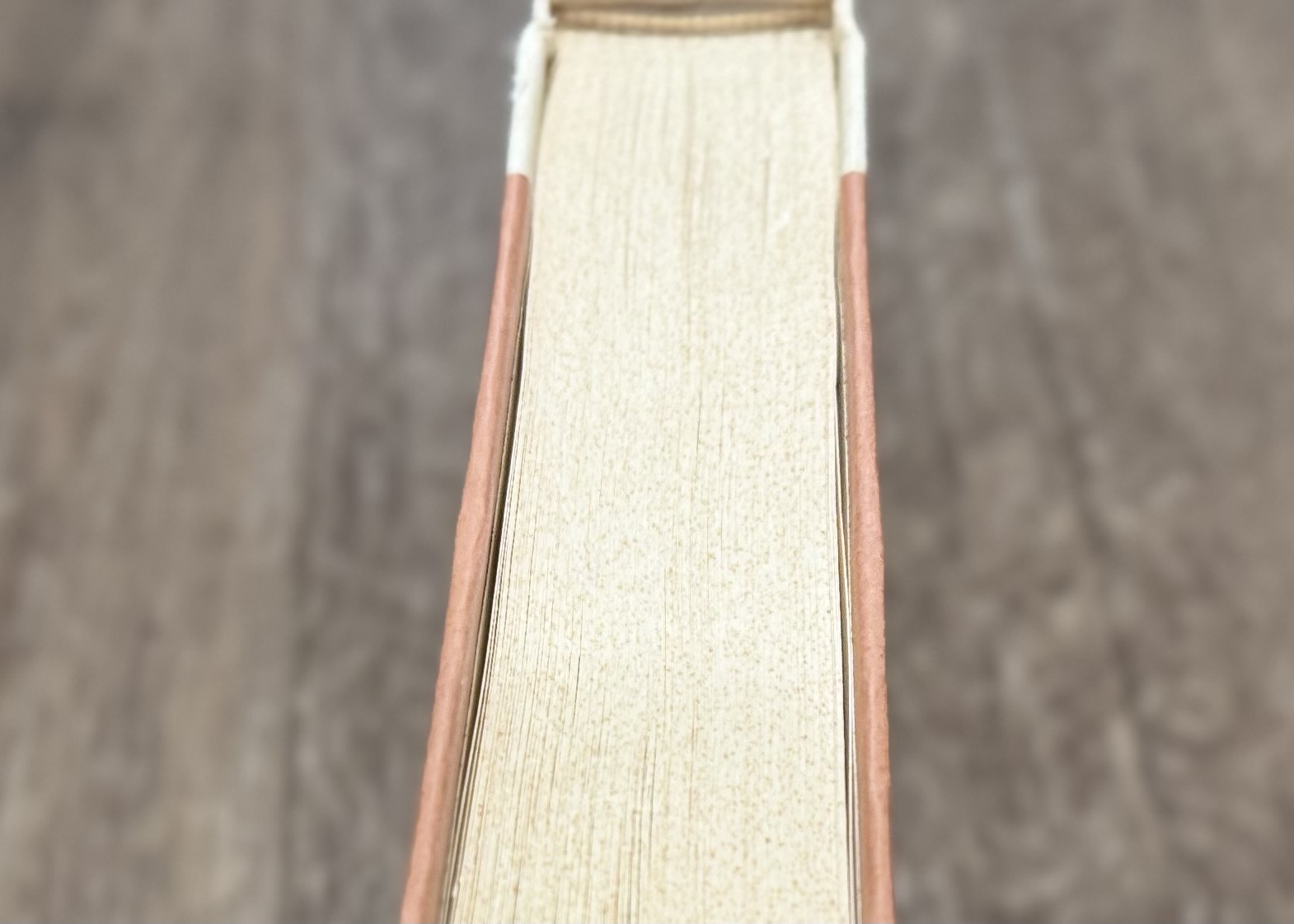
Example of foxing.
Cracked spine, cracked hinges, lean
- What it looks like
- Lean is the mild form: the spine is a little off square, as on the Very Good card. Cocked is the pronounced form: twisted or tilted well out of square, as on the Good card. A cracked hinge may show a split in the endpaper where the cover meets the text block, while a broken hinge involves weakened or failed structural attachment.
- What it does to the grade
- Mild spine lean may be consistent with Very Good, while more pronounced lean may warrant Good. Cracked hinges generally lower the grade substantially, depending on the extent of the split and whether the binding remains secure. Detached boards indicate severe structural damage and typically warrant Poor.
Torn, ripped or missing pages
- What it looks like
- A closed tear is a split with no paper lost. An open tear or loss means paper is missing.
- What it does to the grade
- Margin tears matter less than tears into the text. A missing text leaf makes it an incomplete copy, which must be described as one.
Writing, inscriptions, bookplates
- What it looks like
- Previous ownership marks may include handwritten names, gift inscriptions, bookplates (labels identifying a book’s owner), prices, or other writing, commonly found on the endpapers or inside covers.
- How to tell it apart
- Author signatures and inscriptions are evaluated separately for their potential collectible value and should not be treated the same as ordinary ownership marks.
- What it does to the grade
- These markings can affect a book’s condition grade depending on their size, location, prominence, and extent. A small, neatly written name may have less impact than extensive writing or markings that obscure printed text.
- Can it be fixed?
- Attempts to remove writing or bookplates may leave erasure marks, stains, torn paper, or even missing portions of a page. Such damage should be described separately and considered when assessing the book’s overall condition.
Jacket tears, chips, tape
- What it looks like
- Dust jackets may develop tears, chips, or other damage through handling and age. A closed tear is a split in the paper where no material is missing, while a chip is an area where part of the jacket paper has been lost, often along the edges, corners, or spine ends.
- What it does to the grade
- The effect on condition depends on the size, location, and extent of the damage. Tape used to repair tears can discolor the paper, leave adhesive residue, or cause additional deterioration over time. Both the original damage and any repairs should be considered when assessing condition.
Facsimile and married jackets
- What it is
- A facsimile jacket is a reproduction of the original, while a married jacket is an authentic jacket taken from another copy of the book. Neither should be represented as the jacket originally accompanying that particular copy, and both should be clearly disclosed.
Price-clipped jacket
- What it looks like
- A dust jacket is described as price-clipped when the portion of the flap containing the original printed price has been cut away, typically from the front flap.
- What it does to the grade
- Price-clipping can affect a jacket’s condition and collectible value. For certain Stephen King editions, the original printed price is also an important identifying feature that helps distinguish jacket printings or states. Its removal can make verification more difficult. The significance of price-clipping depends on the particular edition and should be considered alongside the jacket’s overall condition.
Water damage
- What it looks like
- Signs include tide lines (stains with darker edges), cockled or wavy pages, warped boards, color bleeding, and musty odors.
- What it does to the grade
- Moisture can weaken paper and bindings and promote mold growth. The impact on condition depends on the extent and severity of the damage.
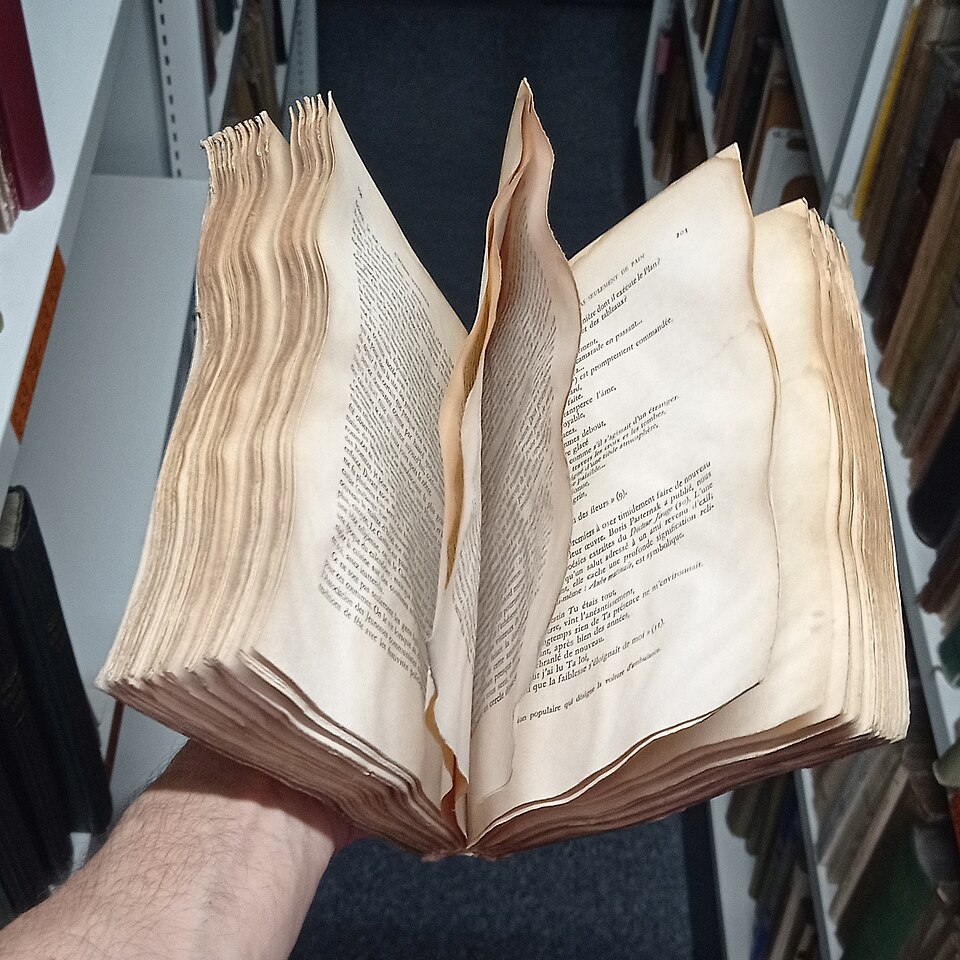
Example of cockled pages from water exposure.
Photo: Adrian Tync, via Wikimedia Commons (CC BY-SA 4.0), unchanged. Source

Remainder marks
- What it looks like
- A remainder mark is a line, dot, spray, or stamp, usually on the bottom edge, showing that unsold stock was offered again at a discount.
- What it does to the grade
- No fixed deduction in the True Value model. Always disclose a remainder mark.

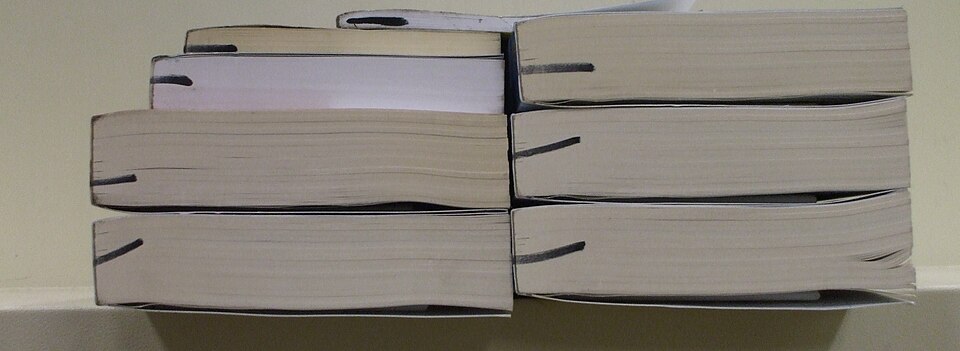
Slash remainder marks on the page edges.
Photo: Wikimedia Commons (public domain). Source

Sun fade
- What it looks like
- Exposure to light can lighten or unevenly fade covers, spines, and jackets. This may dull colors or create visible contrast.
- What it does to the grade
- Its effect on condition depends on severity and whether it’s uniform or patchy.
Ex-library
- What it looks like
- Ex-library copies often have labels, stamps, pocket removals, or other institutional markings and wear. They may also show reinforced bindings or mismatched jackets.
- What it does to the grade
- Ex-library copies are usually valued lower by collectors, but still described by their specific defects.
Smoke and odor
- What it looks like
- Persistent smells such as smoke, mildew, or heavy perfume.
- What it does to the grade
- Odors should be disclosed and described by intensity when possible.
- Can it be fixed?
- Odors can be difficult or impossible to remove.
Stickers and residue
- What it looks like
- Price stickers, store labels, or their residue can discolor, tear, or stain covers and jackets.
- What it does to the grade
- Stickers and residue should be noted with location and extent.
Repairs and restoration
- What it looks like
- Repairs and restoration may include reglued hinges, recolored jackets, or added tape.
- What it does to the grade
- Professional conservation should be disclosed and described. Amateur repairs are treated as damage and noted by their specific effects.
Insect damage, brittle or browned paper, warping
- What it looks like
- Insect damage may appear as small holes, tunnels, or frass. Brittle or browned paper can crack during handling. Warping may affect boards or text blocks, causing distortion or stiffness.
- What it does to the grade
- Describe each by location and severity.
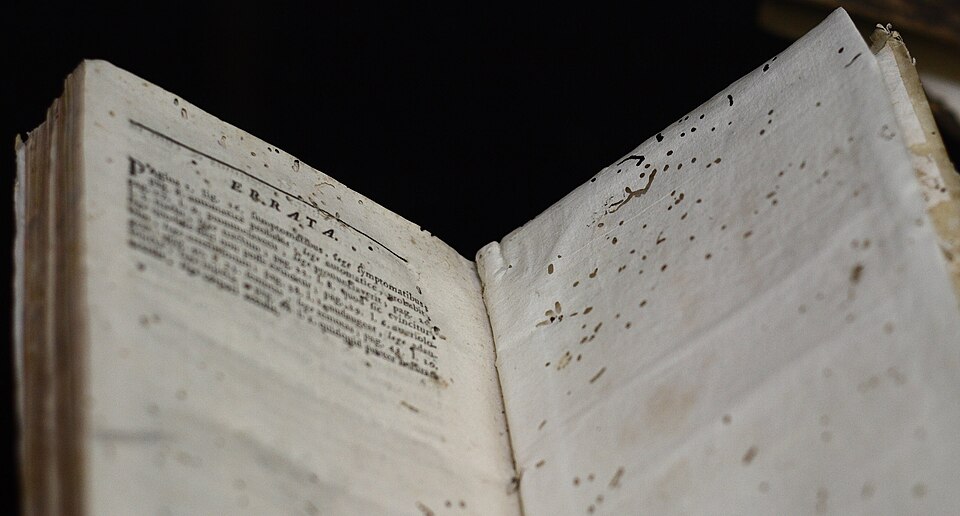
Example of insect damage to a page.
Photo: Ragesoss, via Wikimedia Commons (CC BY-SA 4.0), unchanged. Source

Not a condition problem: book club editions
This is the most common mistake new Stephen King collectors make. A book club copy is a different edition, not a lower grade.
An explicit “Book Club Edition” designation is definitive for the item bearing that designation. Other characteristics are clues that should be evaluated together.
- “Book Club Edition” printed on the dust jacket flap, often accompanied by the absence of a printed price.
- A small blind-stamped symbol near the bottom of the rear board.
- Absence of a “First Edition” statement on the copyright page.
- A gutter code that differs from the trade first printing. Early Doubleday book club editions often have gutter codes, so their presence alone is not conclusive.
- Differences in size, thickness, or weight compared with the trade edition.
- Differences in binding materials, board colors, spine lettering, or construction. Some book club editions have bindings nearly identical or identical to their trade counterparts.
Identification points differ by title. Check the copy against that title's catalog page.
How grades map to True Value
A Very Good / Very Good copy is modeled at 60% of the Fine/Fine True Value.
Questions new collectors ask
The seller says Very Good, but it looks Good to me.
Grade the copy from the cards above, not from the adjective. Compare what you see with the Very Good and Good cards. A cocked spine or old tape on the jacket, for example, is on the Good card. Ask for the photos in the checklist, or post them on the forum for a second opinion.
Is a signed copy graded differently?
No. Condition is the book and the jacket. An author signature or an author inscription can add value, and it is described separately. An owner’s name or a gift inscription is an ownership mark. It can lower the grade, depending on its size and where it is; see Writing, inscriptions, bookplates.
Does a remainder mark make it a book club edition?
No. A remainder mark shows that unsold stock was offered again at a discount. A book club edition is a different edition. You can have either one without the other.
Can I clean mold off?
No. Isolate the book and ask a conservator. See Mold and mildew.
Is a facsimile jacket worth anything?
A facsimile is not the jacket the book was issued with. Price the copy as a book without its original jacket, and never pay a Fine-jacket price for a substitute. A seller should always disclose a facsimile.
Educational only. This page is not a professional appraisal, and a grade here is not a promise of what a particular copy will sell for. When you are unsure about a book in front of you, ask on the forum.